Transcription
Original in French · printed
Printed page (p. 72 of a collection); the picture of the arms is not in the photo.
Original text (French)
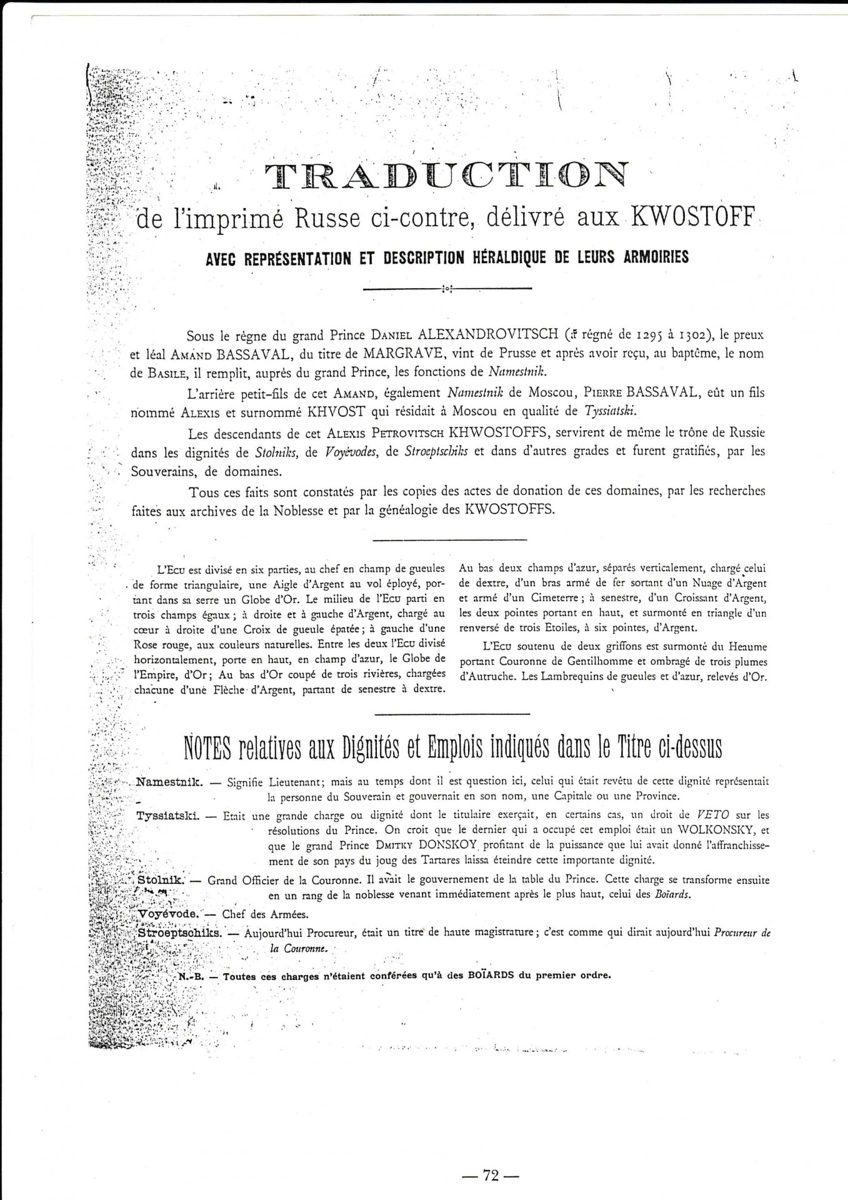
Traduction de l'imprimé russe ci-contre, délivré aux Kwostoff, avec représentation et description héraldique de leurs armoiries
Sous le règne du grand Prince Daniel Alexandrovitch (qui régna de 1295 à 1302), le preux et léal Amand Bassaval, du titre de margrave, vint de Prusse et, après avoir reçu au baptême le nom de Basile, il remplit auprès du grand Prince les fonctions de Namestnik.
L'arrière-petit-fils de cet Amand, également Namestnik de Moscou, Pierre Bassaval, eut un fils nommé Alexis et surnommé Khvost, qui résidait à Moscou en qualité de Tyssiatski.
Les descendants de cet Alexis Petrovitsch Khwostoffs servirent de même le trône de Russie dans les dignités de Stolniks, de Voyévodes, de Stroeptschiks et dans d'autres grades, et furent gratifiés par les Souverains de domaines.
Tous ces faits sont constatés par les copies des actes de donation de ces domaines, par les recherches faites aux archives de la Noblesse et par la généalogie des Kwostoffs.
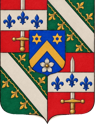
L'écu est divisé en six parties : au chef, en champ de gueules de forme triangulaire, une aigle d'argent au vol éployé, portant dans sa serre un globe d'or. Le milieu de l'écu parti en trois champs égaux ; à droite et à gauche d'argent, chargé au cœur à droite d'une croix de gueules épatée, à gauche d'une rose rouge aux couleurs naturelles. Entre les deux, l'écu, divisé horizontalement, porte en haut, en champ d'azur, le globe de l'Empire, d'or ; au bas, d'or coupé de trois rivières, chargées chacune d'une flèche d'argent partant de senestre à dextre. Au bas, deux champs d'azur séparés verticalement, chargé celui de dextre d'un bras armé de fer sortant d'un nuage d'argent et armé d'un cimeterre ; à senestre, d'un croissant d'argent, les deux pointes portant en haut, et surmonté en triangle d'un renversé de trois étoiles, à six pointes, d'argent.
L'écu, soutenu de deux griffons, est surmonté du heaume portant couronne de gentilhomme et ombragé de trois plumes d'autruche. Les lambrequins de gueules et d'azur, relevés d'or.
Notes relatives aux dignités et emplois indiqués dans le titre ci-dessus
Namestnik. — Signifie lieutenant ; mais au temps dont il est question ici, celui qui était revêtu de cette dignité représentait la personne du Souverain et gouvernait en son nom une capitale ou une province.
Tyssiatski. — Était une grande charge ou dignité dont le titulaire exerçait, en certains cas, un droit de veto sur les résolutions du Prince. On croit que le dernier qui a occupé cet emploi était un Wolkonsky, et que le grand Prince Dmitry Donskoy, profitant de la puissance que lui avait donnée l'affranchissement de son pays du joug des Tartares, laissa éteindre cette importante dignité.
Stolnik. — Grand officier de la Couronne. Il avait le gouvernement de la table du Prince. Cette charge se transforma ensuite en un rang de la noblesse venant immédiatement après le plus haut, celui des Boïards.
Voyévode. — Chef des armées.
Stroeptschiks. — Aujourd'hui procureur, était un titre de haute magistrature ; c'est comme qui dirait aujourd'hui procureur de la Couronne.
N.-B. — Toutes ces charges n'étaient conférées qu'à des Boïards du premier ordre.
English translation
Translation of the Russian printed document opposite, issued to the Kwostoffs, with a picture and heraldic description of their arms
In the reign of Grand Prince Daniel Alexandrovich (who reigned from 1295 to 1302), the valiant and loyal Amand Bassaval, with the title of margrave, came from Prussia and, having received at baptism the name of Basil, held the office of Namestnik under the Grand Prince.
The great-grandson of this Amand, Pierre Bassaval, also Namestnik of Moscow, had a son named Alexis and nicknamed Khvost, who lived in Moscow as Tysyatsky.
The descendants of this Alexis Petrovich Khvostov likewise served the throne of Russia in the dignities of Stolniks, Voivodes, Stryapchiks and in other ranks, and were rewarded by the Sovereigns with estates.
All these facts are established by the copies of the deeds granting these estates, by research in the archives of the Nobility and by the genealogy of the Khvostovs.
The shield is divided into six parts: in chief, on a triangular field gules, an eagle argent displayed, holding in its talon an orb or. The middle of the shield is divided into three equal fields: to the right and to the left argent, charged in the centre on the right with a cross pattée gules, on the left with a red rose in its natural colours. Between the two, the shield, divided horizontally, bears in the upper part, on a field azure, the imperial orb or; in the lower part, or, crossed by three rivers, each charged with an arrow argent pointing from sinister to dexter. In base, two fields azure divided vertically: the dexter charged with an arm in armour issuing from a cloud argent and holding a scimitar; the sinister with a crescent argent, horns upward, surmounted by three six-pointed stars argent in an inverted triangle.
The shield, supported by two griffins, is surmounted by a helmet bearing a nobleman's coronet and shaded by three ostrich feathers. The mantling gules and azure, lined or.
Notes on the dignities and offices mentioned in the title above
Namestnik. — Means lieutenant; but at the time in question, the holder of this dignity represented the person of the Sovereign and governed a capital or a province in his name.
Tysyatsky. — Was a great office or dignity whose holder had, in certain cases, a right of veto over the decisions of the Prince. The last to hold this office is thought to have been a Volkonsky, and Grand Prince Dmitry Donskoy, using the power that the liberation of his country from the Tatar yoke had given him, let this important dignity lapse.
Stolnik. — Great officer of the Crown. He was in charge of the Prince's table. This office later became a rank of nobility coming immediately after the highest, that of the Boyars.
Voivode. — Commander of the armies.
Stryapchiks. — Today procurator; it was a title of high magistracy, rather like what would today be called Crown prosecutor.
N.B. — All these offices were conferred only on Boyars of the first rank.